
How to Search Civil Dockets
Start at the Arizona Public Access Case Lookup. Get past the CAPTCHA. From there, look up a civil case by its full case number. You can also search by a party's legal name. When the site lets you narrow the results, choose Navajo County or the specific court. Keep in mind what Public Access is and is not. It serves up free case information, not the official case file. It also leaves out probate matters along with other protected categories.
Know where the filing lives before you search. A civil case in Navajo County sits either in Superior Court or in one of the county's six Justice Courts. That single fact decides which clerk holds the docket. It also decides whether case images are available, and which request route you will use for the court records.
- Use the court and full case number printed on the most recent notice when possible.
- Search Public Access and verify the case category, filing date, parties, and status.
- Read the event history in date order, including service, motions, minute entries, and orders.
- Check eAccess for an eligible Superior Court filing or judgment image.
- Request missing, older, or certified records from the clerk that keeps that court’s file.
Navajo County Civil Docket Routes
Money limits split the two courts. Justice Courts in Navajo County take civil disputes up to $10,000. They also handle small claims and other limited matters. Anything above that ceiling goes to Superior Court. That court also holds family and probate case types. Probate stays in Superior Court and never shows up in statewide Public Access. So a missing online result may just mean an exclusion. It does not mean you contacted the wrong clerk.
| Case type | Court level | Record holder |
|---|---|---|
| General civil above $10,000 | Navajo County Superior Court | Clerk of the Superior Court |
| Limited civil up to $10,000 | Justice Court | Exact precinct clerk |
| Small claims | Justice Court | Exact precinct clerk |
| Family or probate | Superior Court | Clerk, subject to access rules |
The clerks at the six precincts each run their own shop. No countywide civil docket office gathers Navajo County's Justice Court records in one place. That is why the issuing court printed on the case papers matters so much when you plan a docket search.
What a Civil Docket Shows
Look at the header first. On a Navajo County civil docket, that header can carry the court, the case number, the case category, the filing date, the status, and the judicial officer assigned. Party rows then name who is suing whom. Think plaintiff and defendant, or petitioner and respondent, wherever that information is public. The case history tells the rest of the story: a complaint or petition, a summons, service, an answer, motions, responses, notices, minute entries, orders, hearings, trial, and judgment.
| Case Number | The exact court-assigned identifier; CV can be a civil category, but formats vary. |
|---|---|
| Parties | Public names and roles, plus counsel association when shown. |
| Filings | Pleadings, notices, service records, and other accepted papers. |
| Settings | Event type, date, time, location, and division when published. |
| Disposition | Judgment, dismissal, default, or another status; the signed order controls. |
Remember that a docket is only an index and a history. The pleading, the order, the judgment itself is a separate document. A printout from a portal does not count as a certified copy of any court filing.
Navajo County Civil Motion Entries
A motion is a request. It asks the court to rule one way, but the entry itself decides nothing. Expect the other side to answer with a response. The side that filed may then answer back with a reply. A hearing or oral argument may come next. Want the real outcome of a Navajo County civil docket entry? Look for the court's minute entry, a signed order, or the judgment. Those documents, and only those, state what the court actually did. Knowing this saves readers from a very common mistake.
- Motion
- A party’s request for a procedural or substantive ruling.
- Minute entry
- The clerk’s written record of action taken at a proceeding.
- Order
- A judicial direction that grants, denies, or otherwise resolves a matter.
- Judgment
- The court’s enforceable decision on claims or relief.
A notice of settlement only tells you the parties reached an agreement. It does not prove judgment was entered. Check the docket events that follow, and pull the operative order whenever the final result matters.
Types of Civil Cases on the Docket
Civil dockets in Navajo County do not all live in one place. Superior Court carries the major civil disputes, along with family and probate cases. The Justice Courts run the lower-dollar civil track, and that includes small claims. Where a case sits shapes how you search for it. Access rules differ by category. State rules can shield an entire case type, or just one document inside it.
- Contract, debt, tort, and property claims within the court’s jurisdiction
- Small claims assigned to a Navajo County Justice Court
- Family matters such as divorce, paternity, support, and parenting time
- Probate matters held by Superior Court but excluded from statewide Public Access
- Post-judgment enforcement and appeal filings tied to a civil case
Even when most of a civil file is open, protected data can still be redacted. Searching a docket and pulling the documents are two separate questions.
Navajo County Civil Service Records
Service delivers court papers to the other side in a Navajo County civil case. When it happens, a proof or certificate of service may show up as a docket entry. Here is the catch: the office that serves papers is not the office that keeps the docket. The Sheriff civil service office, at 137 W. Arizona in Holbrook, handles Superior Court civil process for Navajo County. It warns that service or notice can take up to 15 business days, since circumstances vary.
Justice Court and municipal cases work differently. Constables handle that process, not the Sheriff's Superior Court channel. So a filer should watch two things. One is the service attempt itself. The other is the clerk's later proof-of-service entry on the court docket. Neither one substitutes for the other.
Remember that service timing says nothing about when the court will set a hearing. It also says nothing about when the court will rule on a motion. That is a separate step entirely.
Settings and Hearings on Civil Dockets
A setting on a civil docket can mean several things. It might be a status conference, a motion hearing, an evidentiary hearing, a trial, oral argument, or a family resolution event. The case history keeps the notices and any earlier settings on file. Navajo County also posts Superior Court calendar PDFs broken out by Division I through IV. There are also Commissioner/Pro Tem and visiting judge calendars. Before you count on a date, match the assigned division and the case number.
A reset moves an event forward. It does not erase the old docket entry. The earlier date stays visible in the history. Compare the newest minute entry or notice against the current Navajo County court calendar. If the two conflict, the current court notice controls. Calling the right clerk or division beats assuming a stale date meant the hearing was cancelled. Do not assume that. Ask instead.
Navajo County Civil Docket Documents
Arizona eAccess is where eligible Navajo County Superior Court civil document images live. Coverage starts with cases filed on or after July 1, 2010. You will need an account to buy anything, and per-document or subscription charges may apply. Sealed or restricted images stay off limits no matter what. Do not mix up the free Public Access index with the paid document side of the service. One side is free. The other charges for images.
Work from the docket's event list first. Find the exact complaint, order, or judgment you need. Then purchase just that eligible image or ask the clerk for it. For older Navajo County civil court records, the Clerk's published research and microfiche option may be the only route. Age matters here.
Navajo County Civil Post-Judgment Dockets
A civil docket marked "disposed" is not always finished. The main claim may have ended, yet writs, garnishment papers, a satisfaction of judgment, new motions, or a notice of appeal can add later entries. Read each term with the filed order behind it. A stay only pauses action. A remand sends the matter back after review. Guessing from a short event label is a bad idea.
Default deserves the same care. A request for default is not the same as a default judgment. Check the final docket history to see whether the court actually entered judgment after the required process.
Navajo County Civil Record Requests
Copies of a Navajo County civil court record start with the Clerk of the Superior Court. That office holds the civil docket files. The current records form goes to navajorecords@courts.az.gov, by mail to P.O. Box 668, Holbrook, AZ 86025, by fax at 928-524-4261, or to the Holbrook counter. The main Clerk line is 928-524-4188. Show Low Superior Court has hearings, but no Clerk front-office service there.
Fill out the case number and party identifiers. Add an exact record description, filing or hearing dates, quantity, copy type, and delivery choice. Email or pickup costs nothing extra for delivery. Mail or fax adds $8, and card payments carry a 2.39% convenience fee. Justice Court civil records are different. Contact that precinct directly instead of sending the Superior Court form without checking.
Navajo County Civil Request Declarations
Arizona law treats a public-record request made for commercial purpose differently from an ordinary one. The A.R.S. section 39-121.03 page from the Legislature sets out that statute.
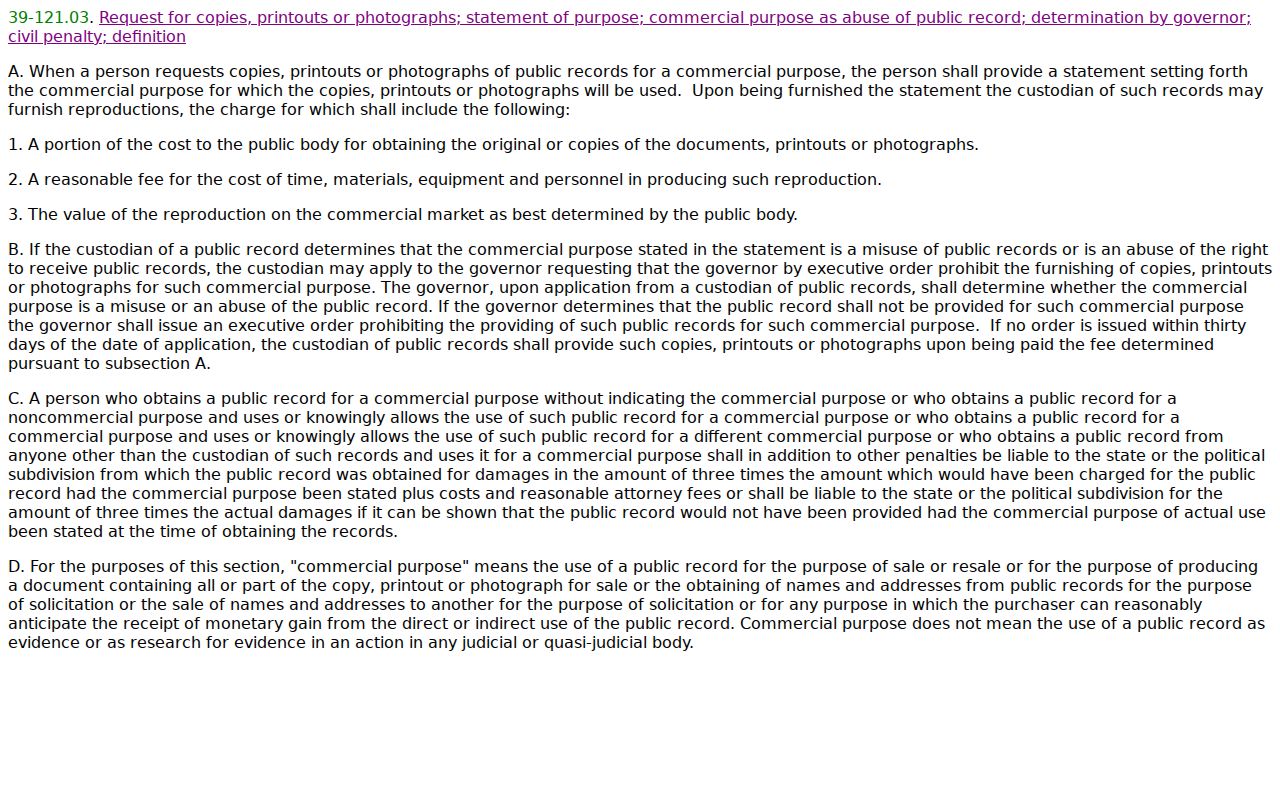
That statute backs the Yes/No commercial-purpose box on the Navajo County records form. Answer "yes" and you must state your intended use. Rule 123 still governs access to judicial records, so declaring a purpose never opens a sealed filing.
Navajo County Civil Record Duties
The public-body maintenance and copy duties appear in A.R.S. section 39-121.01.
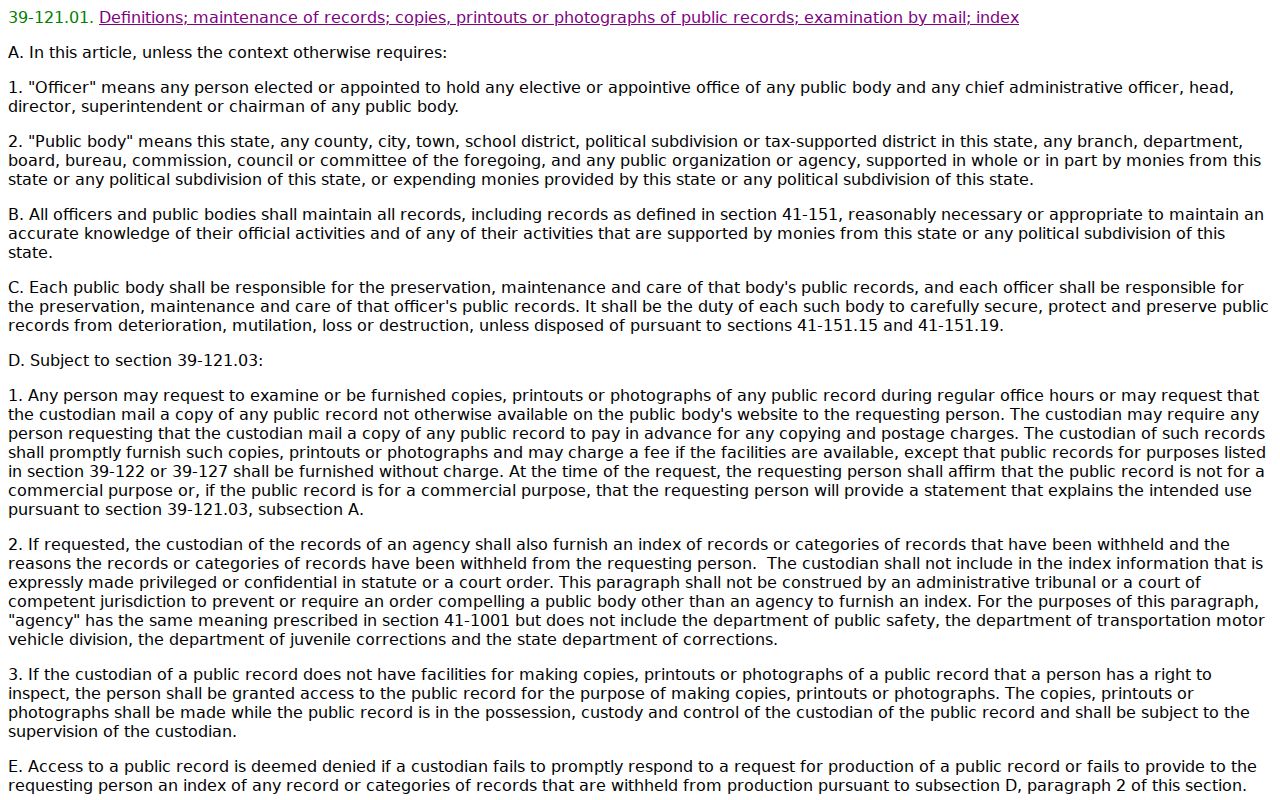
The statute does not replace Arizona Supreme Court Rule 123 for judicial files. It supplies state public-record context only. The court rule, confidentiality law, sealing orders, and redaction duties decide what a clerk may disclose.
Public Access to Civil Dockets
Plenty of Navajo County civil docket entries are open, but not every case category or filing is. Public Access excludes probate, mental-health cases, orders of protection, sealed cases, and protected juvenile information. eAccess also withholds sealed or restricted images. An otherwise accessible filing may still have personal identifiers redacted.
Want an official result? Request a certified judgment or order from the clerk holding the original. A printed public index proves neither completeness nor certification. Access in Arizona turns on the record itself, its category, and any governing court order.
Key Rules:
Arizona Supreme Court Rule 123 governs public access to judicial records.
A.R.S. section 39-121 states Arizona’s general inspection principle.
A.R.S. section 39-121.01 addresses record maintenance and copies, subject to other law.